
How to Check Criminal History in Center Hill
Match each Center Hill record to its custodian. SCSO keeps deputy reports under the police-service agreement. The county jail creates booking entries, the Clerk keeps filed cases, and FDLE keeps statewide history. The contract file is administrative and remains separate from incident records.
- Ask SCSO Criminal Records for the source report, using a report number, date, location, and names when known.
- Search Sumter Jail View under Current, Released, or Both for the booking episode.
- Search CiviTek for the filed county case and read its docket and disposition.
- Call the Clerk if an image, case link, or older Center Hill file is missing online.
- Use FDLE's public search or subject-only fingerprint Personal Review for a broader Florida check.
Sheriff Serves as Contract Chief
Center Hill has no separate police department. Its official agreement assigns the Sheriff the duties of municipal police chief. Deputies remain SCSO employees even though the city sets its desired service level through planning. Incident reports and arrests are therefore Sheriff records, not City Hall police files.
The agreement provides one deputy for 12 consecutive hours each day, with two patrol deputies as backup and a lieutenant-or-higher liaison. Those staffing terms explain the service structure. They do not create a city-only crime database or a separate Center Hill police statistics series.
Sheriff Records for Center Hill
SCSO Criminal Records holds deputy-created Center Hill incident and arrest reports. Requests may go to records@sumterso.org, 352-569-1600, or the Powell Road and Bushnell counters. Identify the event date, location, incident number if known, and desired format.
Include the incident date, place, report number if known, involved names, and desired format. The city may redact protected victim details, juvenile information, active investigative material, medical data, or security information. A redaction is an access boundary, not proof that the omitted fact is false or missing.
Contract and Incident Custodians Differ
Center Hill administrative contact is P.O. Box 649, Center Hill, FL 33514, phone 352-793-4431, and fax 352-568-2264. Use City Hall for city records. County administrative contract material may go to Records@sumtercountyfl.gov, 352-689-4400, at 7375 Powell Road in Wildwood.
Neither administrative route replaces SCSO Criminal Records for a deputy report. The distinction matters: the service agreement explains who provides police coverage, while the incident file documents a particular call or arrest.
Arrests and Bookings in Center Hill
Center Hill has no city jail. Deputies transport arrestees to the Sumter County Detention Center, making SmartWeb Jail View the practical booking log. Search Current, Released, or Both. Current-only can miss a quick release. The county system owns the booking data.
Record the booking number, MNI number, booking time, status, arresting agency, charges, bond, and court case number. The MNI is a master-name identifier; the booking number identifies one intake. A charge is an allegation. The Sumter arrest history page covers the county booking process in greater depth.
A Center Hill Booking Is Not Guilt
Booking data captures intake facts, not a final result. Charges may be changed or dropped after prosecutor review. A case can end through dismissal, nolle prosequi, acquittal, plea, adjudication, or a withhold of adjudication. A withhold is not a dismissal, and a dismissal is not a conviction.
- Disposition
- The recorded outcome of a charge or case.
- Nolle prosequi
- The prosecutor's formal decision not to continue.
- Adjudication
- The court's formal finding of guilt.
- Withhold
- A sentence without formal adjudication, subject to Florida rules.
Follow the case number into CiviTek. If Jail View shows N/A, search later by party name. The court file may not yet be linked, and N/A does not prove that prosecution was declined.
Center Hill Cases in County Court
Center Hill has no municipal criminal court. Sumter County Court hears ordinance prosecutions, misdemeanors, and criminal traffic cases. Circuit Court handles felonies. Search the Clerk's CiviTek OCRS by case number or party name, then narrow by case type or date. Read the docket in order and separate the filed count from the disposition.
| Court Name | Sumter County Court and Circuit Court |
|---|---|
| Case Types Heard | Ordinance, misdemeanor, criminal traffic, and felony cases at the proper county level |
| Case Lookup Channel | CiviTek OCRS, Clerk counter, phone, or specific copy request |
| What the Docket Shows | Filed counts, hearings, orders, disposition, sentence, and financial entries |
| Copies & Fees | Clerk schedules apply; confirm copy, certification, search, and mailing totals |
Twelve Dedicated Hours Explained
The contract's 12-hour dedicated shift does not mean Center Hill lacks service during the rest of the day. Two patrol deputies provide backup, and the agreement includes a senior liaison. The dedicated-hours figure describes staffing, not the hours when a person may report a crime or the span covered by public records.
City-labelled CAD calls offer operational context but are not a verified crime rate. SCSO county totals also cannot be relabeled as Center Hill-only statistics. Request the source report when a specific call matters.
Where Center Hill Records End Up
The report remains with SCSO. Booking goes to the county detention system. Filed charges and outcomes enter the Clerk file, while qualifying submissions reach the state repository. Recent custody may appear before a case number is populated.
Record flow: Sumter County Sheriff's Office › Sumter County Courts › Florida Department of Law Enforcement
Use the city report for event detail, the court docket for outcome, and FDLE for broader Florida repository history. A statewide name result does not reproduce the complete Center Hill police narrative or county case file.
Center Hill's Small-City Context
Center Hill's official 2025 estimate was 1,081, up from a revised 2020 base of 866. It now ranks ahead of Webster and Coleman among incorporated cities. That growth does not create a separate police repository because the Sheriff agreement still controls the local law-enforcement channel.
County planning describes Center Hill as an agricultural town shaped by citrus freezes. Its history helps explain the city's scale and contract model. Current criminal records still move through SCSO, the county jail, the Clerk, and FDLE.
The county cities and communities page provides the official local contact context.
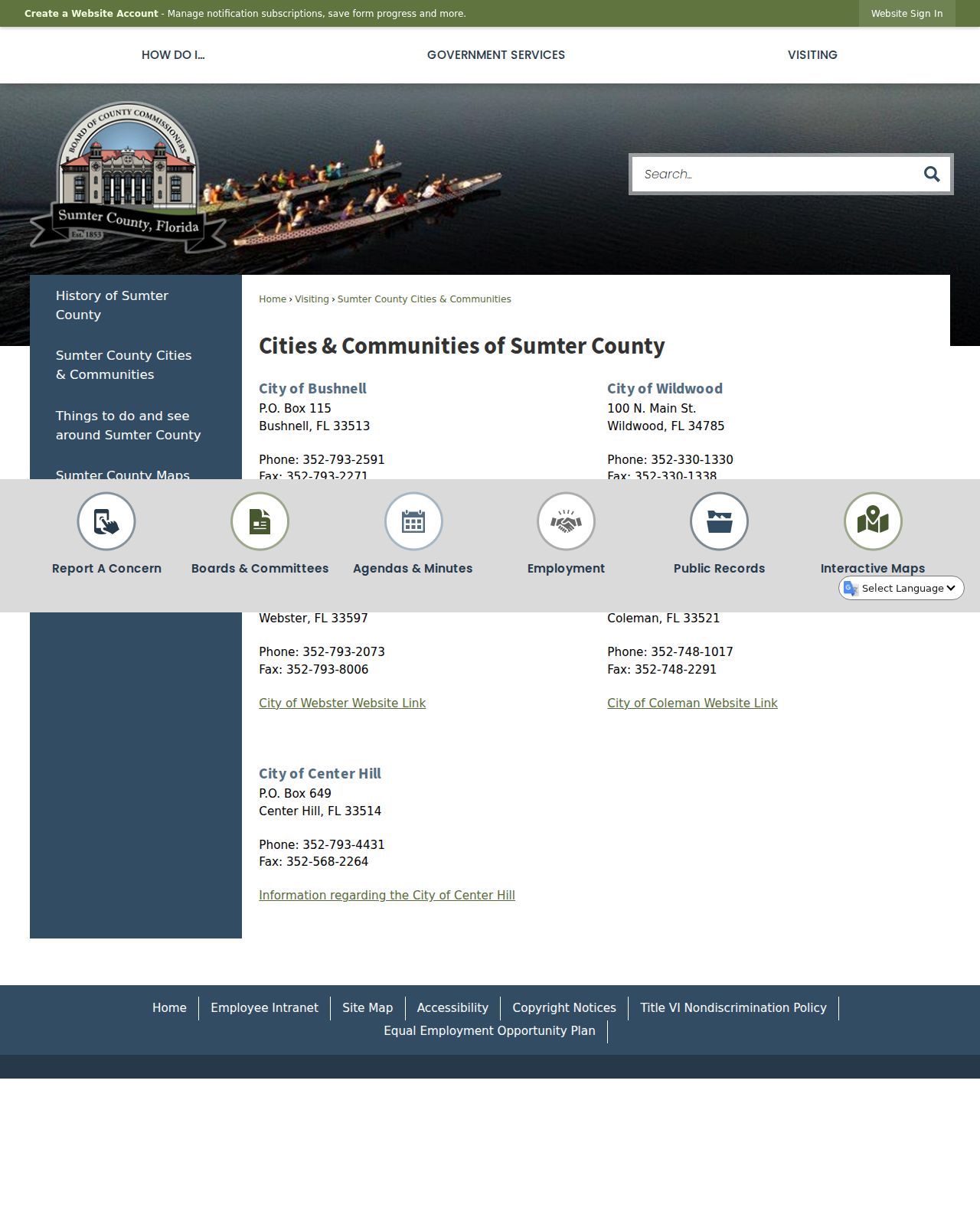
The contact image helps distinguish City Hall administration from the Sheriff office that owns incident records.
Center Hill Requests Split Two Ways
Ask City Hall or the county administrative custodian for the service agreement, planning records, and other contract documents. Ask SCSO for calls, deputy narratives, arrest reports, and booking-related records. A contract file explains the scope of police service but does not reconstruct a deputy's investigation.
This split also guides corrections. An incident-report error belongs with SCSO, a court disposition with the Clerk, and an FDLE repository mismatch with FDLE's personal-review process.
From Center Hill Call to Outcome
A Center Hill call may involve the dedicated contract deputy, one of the backup patrol deputies, or another responding unit. The staffing route does not change the custodian: SCSO keeps the law-enforcement event record. Save the incident number, date, location, and response details available from CAD, then ask for the specific deputy report, CAD log, or 911 record. The public live-call display is not a substitute for any of those source records.
If an arrest followed, search SmartWeb Jail View. Choose Both when current custody is unknown. Record the booking number, MNI number, agency, charges, status, bond, and any court number. A charge is the allegation entered at intake. It can be amended or declined after review. An N/A court field often reflects timing or an unlinked matter, so repeat the Clerk search rather than concluding that no prosecution exists.
Use CiviTek to read the filed case and disposition. Search by exact case number when available, or narrow a party-name search by date and criminal case type. CF commonly identifies felony files, while MM and CT route misdemeanor and criminal-traffic matters. Compare the arrest allegation with the filed count and final order. For any mismatch, correct the source that owns the field: SCSO for its report, the Clerk for the court record, and FDLE through Personal Review for the statewide repository entry.
SCSO publishes charges of 15 cents for a one-sided page, 20 cents for a two-sided page, and one dollar for a certified copy. Media and postage can add actual costs. Extensive work is listed at $18.02 per hour after the first 30 minutes. Ask for an estimate and spending threshold before broad processing begins. The free local arrest check is separate and does not make each report free.
FDLE Personal Review uses fingerprints and carries no FDLE fee, though print rolling may cost money. The paid instant search is name based and can pose same-name risk. Neither replaces a Center Hill report or Sumter court file. Collect the SCSO record and certified Clerk disposition before challenging a state mismatch. Correction, sealing, and expunction are separate processes.
Public Access Rules for Center Hill Records
Florida law permits inspection and copying of nonexempt records. It does not require Center Hill to create a new record. Ask for segregable public portions when an otherwise open file includes protected content. Sealed, expunged, juvenile, and confidential matters do not return to public view through a broad request.
Key Statutes:
Florida Statutes Chapter 119 permits access to nonexempt public records and lawful redaction.
Florida Statutes §943.053 governs FDLE criminal-history dissemination.
Florida Statutes §943.056 provides personal review and challenge rights.