
How to Check Criminal History in Sumter County
No single database holds every part of a Sumter County criminal history. Start with the Sumter Clerk's CiviTek Online Court Records Search for filed charges, docket events, and dispositions. Use an exact case number when one is known. A name search works as a fallback, but spelling variants, dates, court type, and case type help separate similar names. Public access is free and anonymous. Party, attorney, and registered-user access require credentials and only reveal images permitted by Florida's court-access rules.
A useful search begins with a small set of verified facts: the full name, likely spelling, approximate event date, and the place or agency involved. Keep each identifier beside its source. Similar names are common, and a date of birth may not be open in every view. Matching a name and charge alone is not positive identification. Case and booking numbers are stronger links between systems because they identify a specific file or intake episode.
Then compare the court file with the source that fits the question. SmartWeb Jail View shows current and released county custody. The Sheriff's Criminal Records Division supplies its arrest and incident reports. Wildwood Police keeps its own reports. FDLE covers public statewide repository history, while FDC covers state custody and community supervision. Each result has a narrower purpose than the phrase "background check" may suggest.
- Search CiviTek by case number or party name and narrow the criminal case type.
- Read the docket in date order and distinguish a filed count from its final disposition.
- Check SmartWeb when booking, release, arresting-agency, charge, or bond fields matter.
- Request the source report from SCSO, Wildwood Police, or the other arresting agency.
- Use FDLE Personal Review for your own fingerprint-supported Florida history or order Clerk copies when proof is needed.
When CiviTek produces no match, do not jump straight to a statewide name result. Check the spelling, case prefix, date range, and court type first. Older files may require staff retrieval. For a mailed or counter request, bring the defendant name, approximate year, case number if known, and the exact document sought. Ask whether inspection, a plain copy, or a certified copy meets the need. That choice affects both cost and processing.
Search Sumter County Court Records
The Clerk-provided Sumter CiviTek search is the best local starting point for a criminal case. Select Public for anonymous access. A case number is the cleanest key, especially when copied from a jail entry. With only a name, try spelling variants and a useful date range. The court and case-type controls help separate Circuit felony files from County Court misdemeanor and criminal-traffic matters.
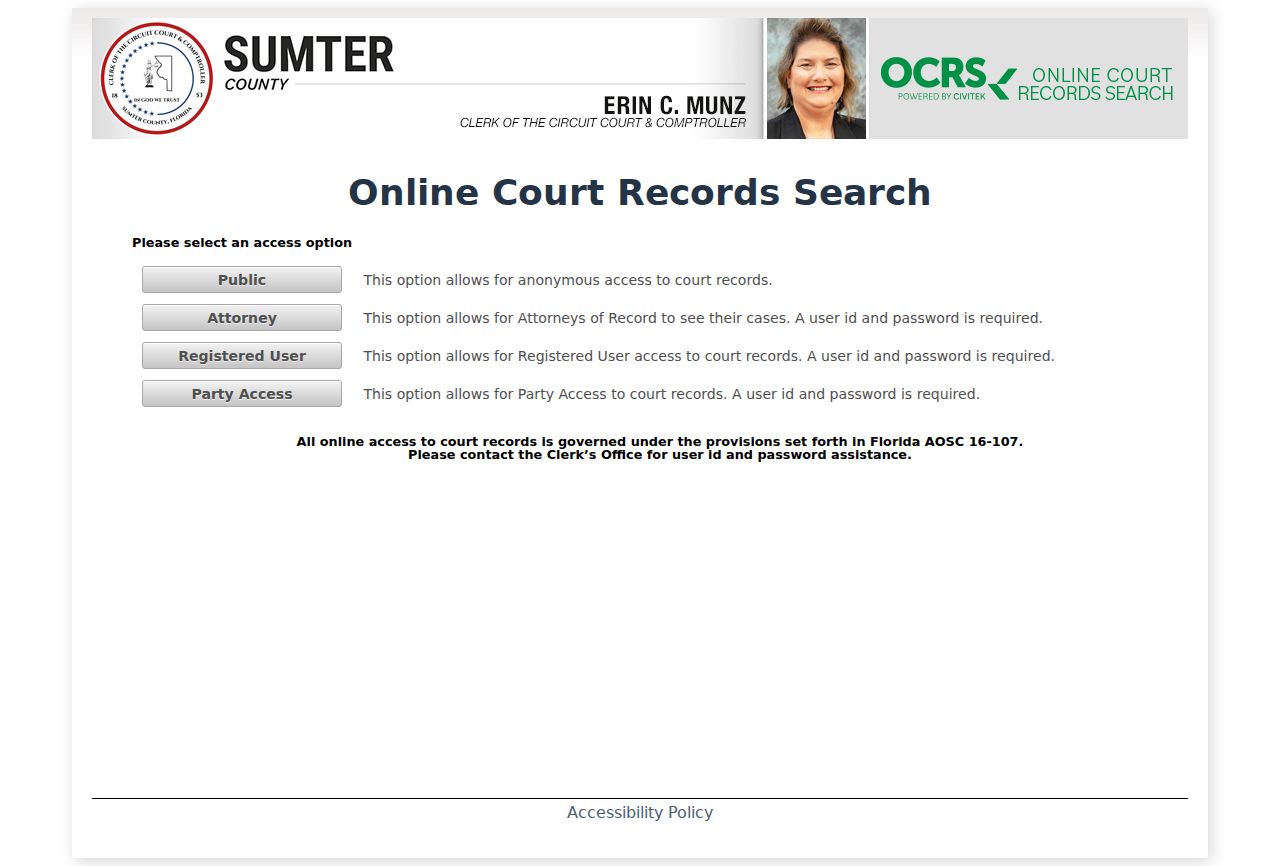
The landing screen shows why access mode matters. Public users can see the public docket and allowed images, but a missing image may still exist behind quality-control review or an access restriction. It does not erase the docket event. The Clerk's online services page is the safe route when an old vendor link or saved address stops working.
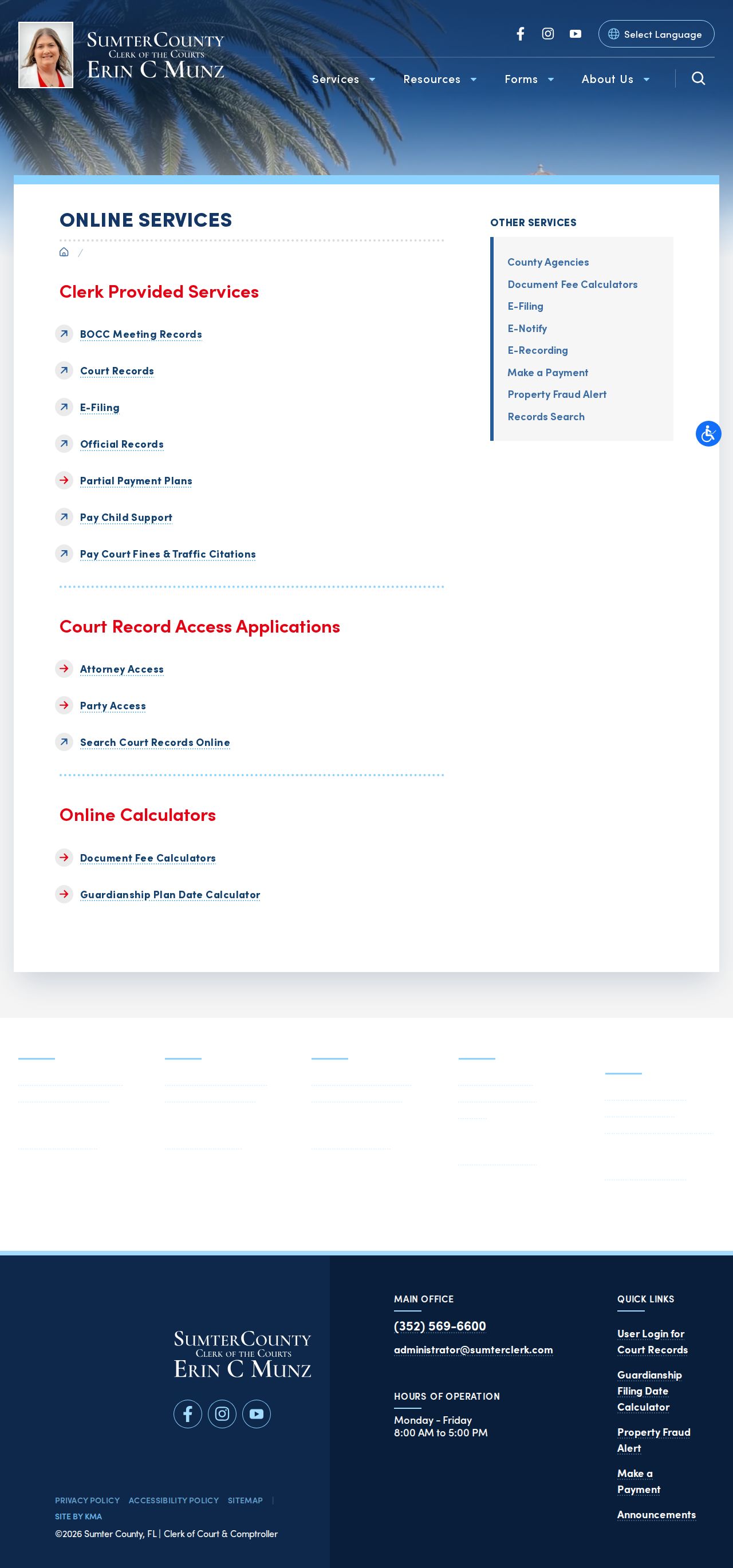
The Clerk page connects records access with applications, payments, and other court services. It also helps readers avoid confusing Official Records at Anderson Avenue with the criminal case counter at the Judicial Center.
| Search control | Best use |
|---|---|
| Case number | Direct route to a known file, including a number taken from Jail View |
| Party or business name | Broad name search; test spelling variants |
| Date of birth | Narrows identity where public controls allow it |
| Court and case type | Limits results to the relevant criminal category |
| Date range | Reduces long result lists and common-name matches |
Case prefixes also help explain the result. `CF` denotes the Circuit felony stream, while `MM` and `CT` commonly route to misdemeanor and criminal-traffic files. A charge can change after arrest. Read later docket entries and the recorded disposition instead of treating the first charge description as the final case. A nolle prosequi means the prosecutor stopped a charge; a withhold of adjudication is not a dismissal.
If a docket appears but its document icon does not open, note the case number, filing date, and document title. Registered access can add only the nonconfidential images authorized for that user. It cannot turn a sealed, juvenile, or protected image into a public record. Call the Clerk when an older file may need retrieval or an image appears to be awaiting quality-control release.
Official Florida Background Checks
The Florida Department of Law Enforcement maintains the state's central repository. Its Instant Florida Criminal History Search is a public demographic search. It costs $24 plus a $1 card-processing charge and produces an immediate, noncertified result. A staff-run certified or noncertified search is also $24. FDLE lists about five business days for a staff noncertified response and six to seven business days for a certified response, apart from mail time.
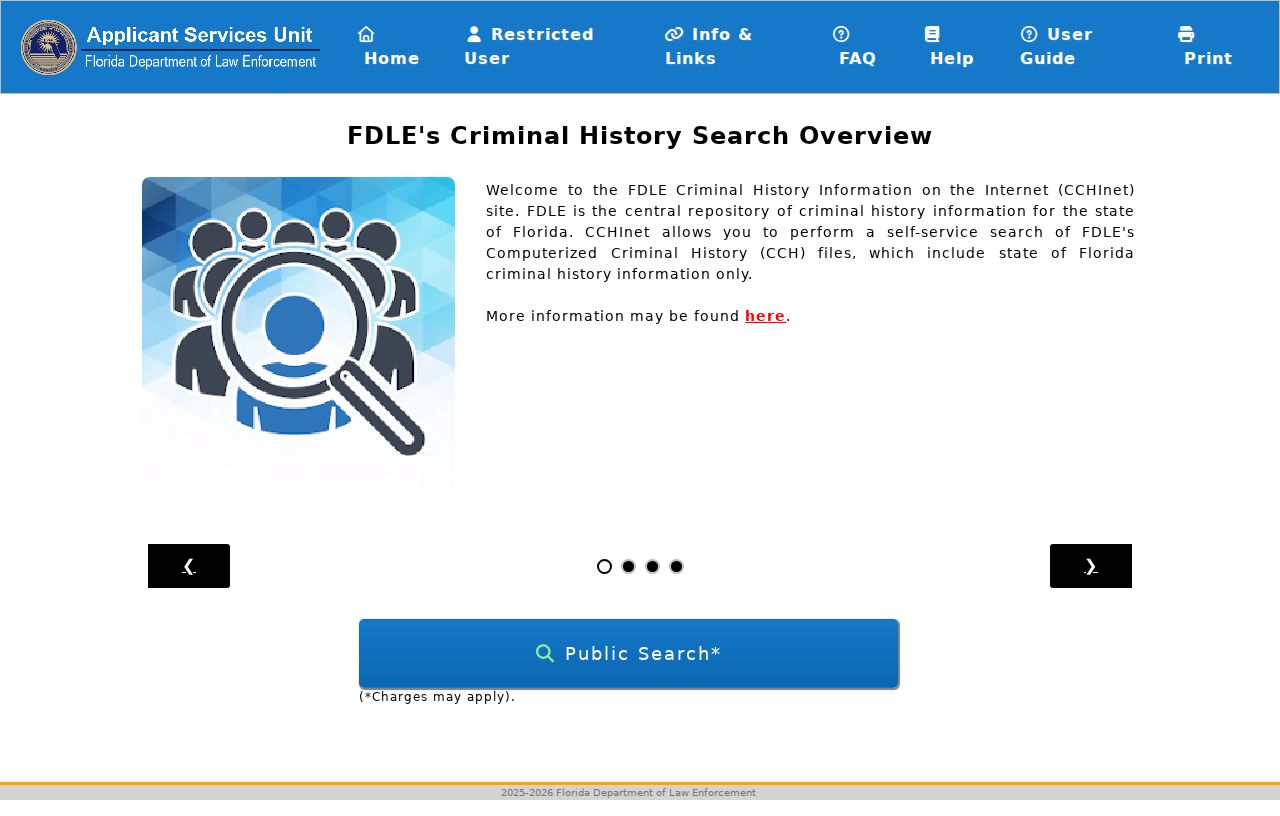
The state interface reaches farther than Sumter County, but a name match is not fingerprint identification and the product does not reproduce a complete Clerk file. Authorized state or national checks use electronic Livescan and an ORI supplied by the receiving agency. FDLE does not create an ORI for a requester. The narrow statutory process should be used only through the official receiving agency.
| Channel | Scope | Published cost | Main limit |
|---|---|---|---|
| FDLE instant | Public Florida history | $24 + $1 | Name based and not certified |
| FDLE staff search | Certified or noncertified Florida result | $24 | Processing and mail time |
| FDLE Personal Review | Your own Florida record | No FDLE fee | Fingerprint submission required |
| SCSO local check | Sumter arrest subset | Free | Current system-date limitation |
The FBI also offers a subject-only Identity History Summary for a published $18 direct-submission fee. That federal product answers a different question from FDLE and from the Sumter Clerk. A county case may contain pleadings and orders that neither repository reproduces. Likewise, an FDLE history may contain an arrest from elsewhere in Florida that cannot appear in Sumter's local court search.
Correct Your Sumter County Record
A person reviewing their own Florida repository record should use FDLE Personal Review. The subject or a designated attorney submits fingerprints taken by a criminal-justice or law-enforcement agency. FDLE charges no review fee, though the local office may charge to roll prints. The completed form and fingerprint card go to the Criminal History Record Maintenance Section in Tallahassee.
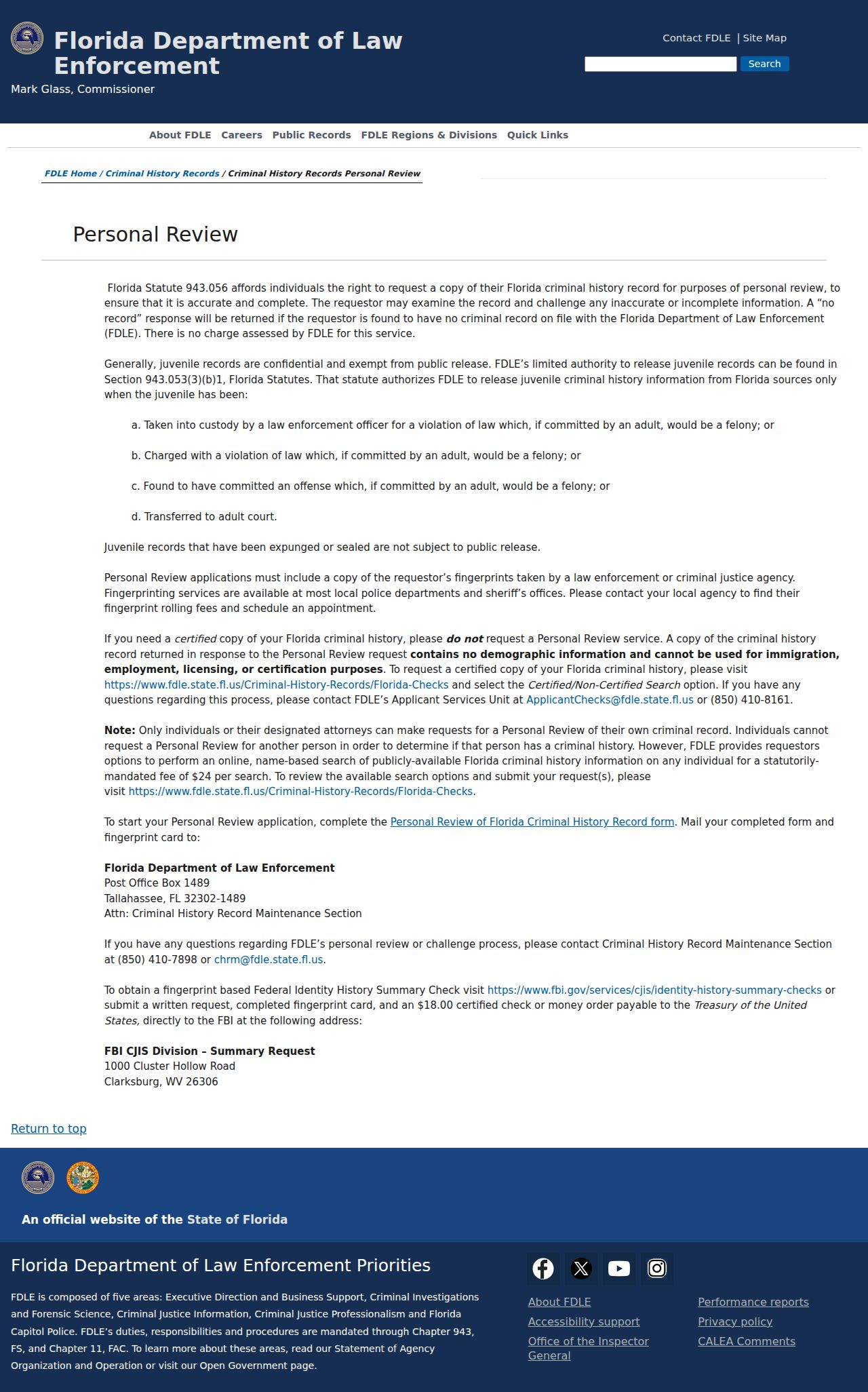
The fingerprint route helps tie the response to the right person. When something looks wrong, identify which custodian owns the fact. The arresting agency owns its original arrest data, the Clerk owns the disposition, and FDLE owns the matched repository entry. A certified Sumter County disposition may support an FDLE challenge, but changing the state display does not by itself remove a lawful Clerk case or booking record. Review questions go to 850-410-7898 or chrm@fdle.state.fl.us.
Correction and record relief are separate tasks. A challenge asks the proper agency to fix data that are inaccurate or incomplete. Sealing or expunction asks for lawful limits on access to an otherwise valid record. Start with the underlying arrest report and certified disposition, since those documents show whether the problem began with the arresting agency, the court outcome, or FDLE's attempt to match the two.
Types of Criminal Records
One Sumter County arrest can create four distinct records. The arresting agency writes the source report. The detention center creates a booking entry. The State Attorney decides what to file, and the Clerk opens the court case. FDLE may later match the arrest and final disposition in its statewide history. Those records can differ without one necessarily being false, because they describe separate stages and are updated by different custodians.
Custody records split again by level. SmartWeb covers the Sumter County jail, FDC covers state prison and community supervision, and the federal Bureau of Prisons covers federal sentenced custody. The Florida registry is a distinct legal-registration product, not a full criminal record.
- Incident and arrest report: the source agency's narrative and event fields.
- Booking record: intake, custody, charges, bond, and housing data, not proof of guilt.
- Court case file: filed counts, docket events, orders, disposition, and sentence.
- State history: FDLE's broader chronology built from agency submissions and matched outcomes.
- Supervision and registry records: separate FDC, parole-review, probation, and FDLE registry products.
A warrant or capias is another distinct item. The court issues it, and the Sheriff receives or executes it. A docket may show issuance even though Sumter offers no full public active-warrant name search. Police reports are also split by creator. Wildwood Police holds its own reports; the Sheriff is the source for deputy reports in Bushnell, Center Hill, Webster, Coleman, and the broader service area.
Calls for service add context but are not another form of conviction record. The SCSO live CAD view lists an incident number, received, dispatched, and arrival times, incident type, city, and location. It does not provide the full event log, 911 audio, officer narrative, or verified crime count. Request those source materials by incident number when needed, and expect lawful redaction. A city label on a call should never be turned into a city crime rate.
Sumter County Warrant Records
Sumter County has no complete official public active-warrant name-search portal. Jail View is not a warrant database; it may show a warrant-based charge only after booking. Call the Sheriff's Civil/Warrants Division at 352-569-1600 when prompt confirmation or instructions matter. A specific Chapter 119 request to Criminal Records is another route. For a warrant or capias tied to a known case, search the Clerk docket and contact the issuing Circuit or County Court.
A missed appearance can lead to revoked bail and an arrest warrant, but a portal entry may lag current court action. Do not infer surrender terms, bond, or resolution from the docket alone. Juvenile and sealed warrants are not ordinary public results. The court or counsel is the right source for next steps on one's own case.
Use a precise request if the phone route does not answer the records question. Include the related case number, issuing court, approximate date, and the specific existing record sought. Chapter 119 does not require SCSO to create a new status report or give legal advice. A booking result can confirm an intake after execution, but it cannot show whether another active warrant exists.
What a Sumter County Criminal Record Shows
The fields depend on the source. A repository history groups identity data with arrest cycles, agencies, charges, outcomes, sentences, and later supervision submissions. A Sumter County court file is organized around the case number, filed counts, attorneys, hearings, docket entries, orders, disposition, and sentence. A booking entry instead centers on one intake event. Read the source label before reading any field as a final outcome.
| Name & Identifiers | Names, aliases, birth data, and agency or state identity numbers where lawfully shown |
|---|---|
| Arrest / Booking Data | Arresting agency, booking and MNI numbers, intake date, status, and bond fields |
| Charges & Statutes | Alleged or filed offense, statute, degree, and amendments, depending on the source |
| Disposition | Dismissal, nolle prosequi, plea, acquittal, adjudication, or withhold as entered by the court |
| Sentence | Custody, probation, fines, costs, restitution, and other ordered terms where public |
| Custody / Supervision Status | County jail, FDC incarceration, or community-supervision status from the proper system |
- Disposition
- The recorded outcome of a charge or case.
- Nolle prosequi
- The prosecutor's formal choice not to continue a charge.
- Withhold of adjudication
- A sentence without formal adjudication under Florida rules; it is not a dismissal.
- Capias
- A court order directing arrest, often tied to a case or missed appearance.
- MNI number
- The jail agency's master-name-index identifier, distinct from one booking number.
From Sumter County Jail to FDC
SmartWeb Jail View is both the local custody locator and the practical recent-booking log. Search Current, Released, or Both. Current-only misses someone released quickly, while Released-only misses a present detainee. Useful fields include booking and MNI numbers, booking time, status, arresting agency, charge and statute, bond, and court case number. An `N/A` case number can reflect pre-filing timing or an unlinked hold. It does not prove there will be no case.
After a state prison sentence or felony community-supervision placement, move to the FDC Offender Search. County absence can mean release, transfer, or a change in status, not dismissal. Search the released county view before moving to the proper state or federal channel.
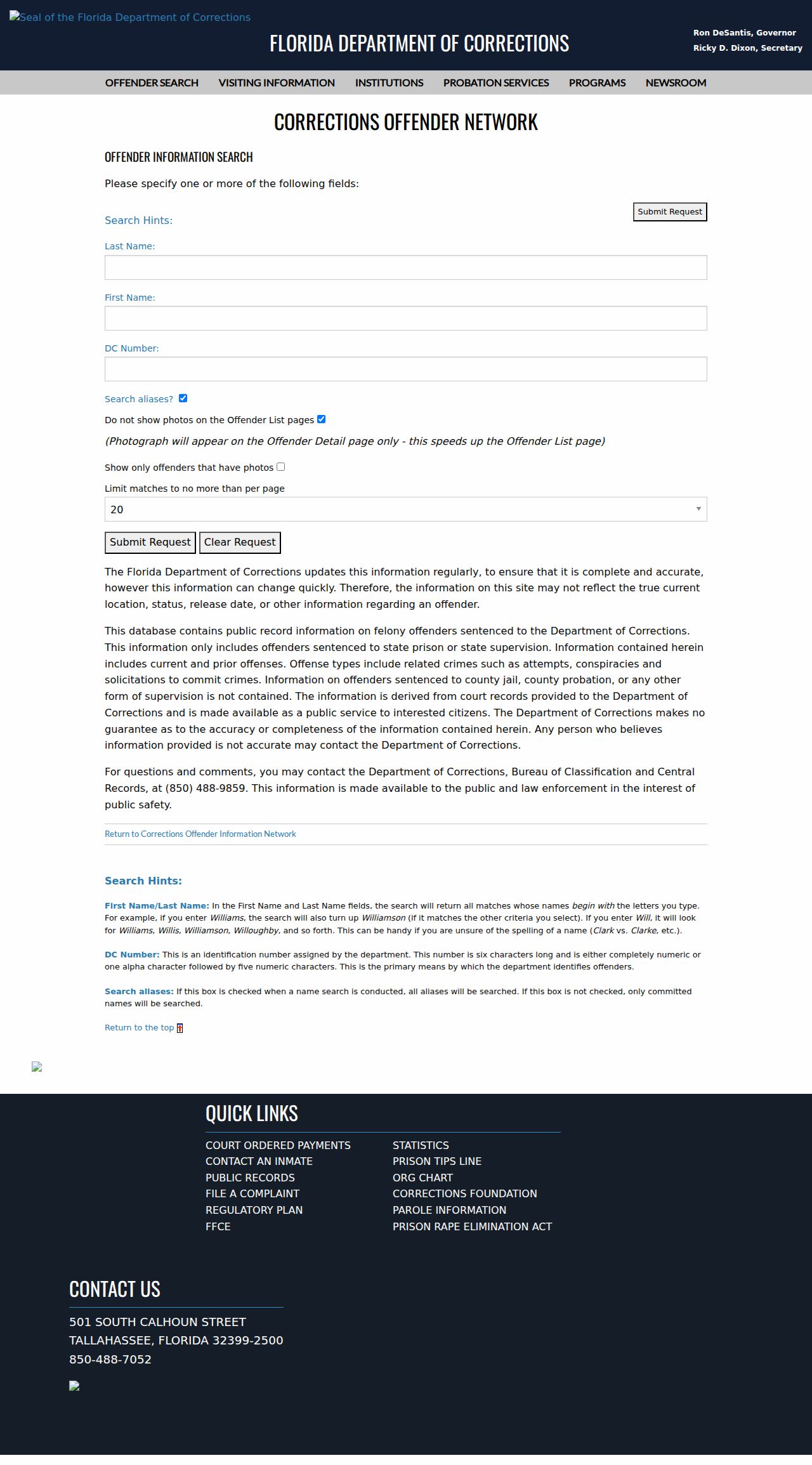
FDC records may show a DC number, supervision type, office, offense, case, and dates, but each live result must be read on its own terms. Sumter misdemeanor probation is handled under county contract by Professional Probation Services, while the Florida Commission on Offender Review handles legacy parole and conditional-release decisions.
The Commission's agenda search can identify a review item by DC number, review category, county, offense, and case number. It is not a universal parole-status database. If an FDC profile shows community supervision but the status remains unclear, contact the office identified in that result. Do not use a Commission agenda, county jail absence, or stale address as proof that supervision ended.
Public Access Laws
Florida Public Records Law gives access to nonexempt government records, but it does not require an office to create an answer or new report. Start with the custodian that made the record. The Clerk holds court files, SCSO and Wildwood Police hold their own reports, the jail holds booking data, FDLE holds statewide history, and FDC holds state custody and supervision data. Active investigations, juvenile material, victim information, protected identifiers, medical data, and security information may be withheld or redacted.
Key Florida Statutes:
Section 119.07 permits inspection and copying of nonexempt public records and allows lawful charges and redaction.
Section 943.053 governs FDLE criminal-history dissemination and applicable fees.
Section 943.056 provides access to and a challenge process for one's own Florida history.
Section 943.0585 sets the court-ordered expunction route.
Section 943.059 governs court-ordered sealing.
Requests should seek existing records, not answers to open-ended questions. Name the record category, agency, date, place, report or case number, and desired format. A purpose is not required, but a reply channel lets the office send a fee estimate and completion notice. The agency should release segregable nonexempt material where required, even when protected fields must be redacted.
Crash records follow an additional rule. For 60 days after a crash, section 316.066 limits access to specified people and agencies, and an eligible requester must provide the required affidavit for each report. After that period, the Florida Crash Portal is the statewide route and the investigating agency remains a fallback. A crash report is not automatically an arrest report. If a criminal charge arose, request the source criminal report and read the Clerk case separately.
Sumter County Records Counters
The main criminal-file counter is at the Sumter County Courthouse/Judicial Center, 215 E. McCollum Avenue, Bushnell. The Clerk's direct Criminal Record Search line is 352-569-6992, and counters generally operate weekdays from 8:30 a.m. to 5 p.m. Mail for Courts/Official Records goes to P.O. Box 2587, Bushnell, FL 33513, with the intended division on the attention line. The Anderson Avenue Official Records office is not a substitute for the criminal court-file counter.
The Fifth Judicial Circuit's Sumter page identifies the local courthouse and judicial offices.
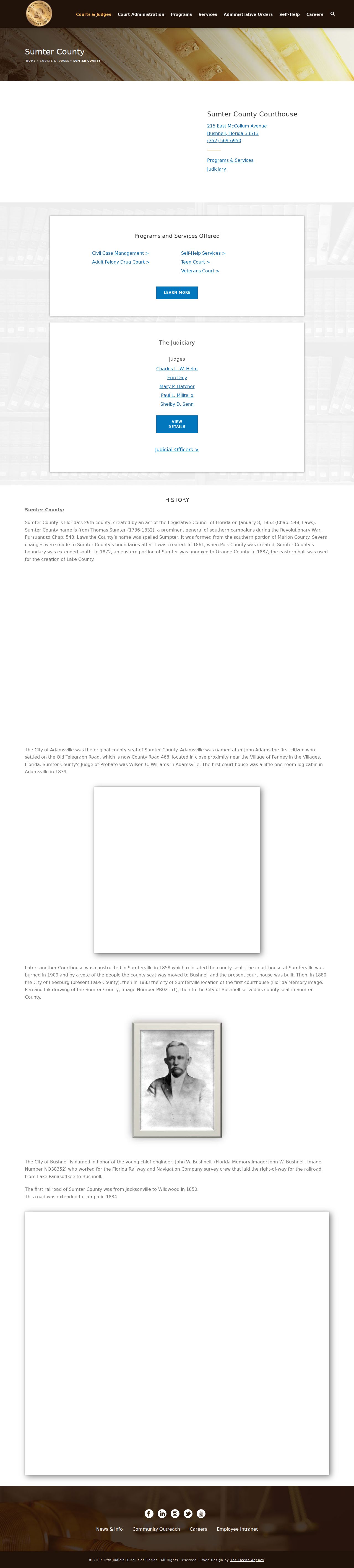
The building is secure, and the public uses the north-side main entrance. SCSO maintains records counters at 7361 Powell Road in Wildwood and 250 E. McCollum Avenue in Bushnell. The Villages Annex offers limited Clerk and Sheriff services, but it is not advertised as the full criminal-file counter. For records tied to a specific agency, a direct email, call, mail request, or counter visit is more useful than sending one broad request to county administration.
The Gloria Rowe Hayward Sumterville Service Center also offers limited services at 215 Gloria Rowe Hayward Way and closes daily from 1 to 2 p.m. Limited service does not mean that every criminal file can be produced there. Confirm the destination first. For an accessibility request, contact the Clerk or Fifth Circuit ADA channel before visiting. Recording inside the secure courthouse requires authorization, so copying a public file at the counter does not create a right to record court operations.
Clerk Criminal Records
215 E. McCollum Avenue, Bushnell
352-569-6992
Weekdays, 8:30 a.m. to 5 p.m.
SCSO Criminal Records
7361 Powell Road, Wildwood
records@sumterso.org
352-569-1600
SCSO Bushnell Counter
250 E. McCollum Avenue, Bushnell
352-569-1600
Electronic Court Reporting operates from Room 167 at the courthouse and provides audio files, not transcripts. Requests can go to sumter_ecr@circuit5.org or 352-569-6970. The office warns that supplied audio can include confidential or exempt information. The State Attorney's Sumter office is also in the Judicial Center, while the Public Defender is at 416 N. Lawrence Street. Each office keeps its own records and is not a substitute for the Clerk.
Reading Sumter County Crime Data
FDLE's 2020 UCR figures are useful as a historical benchmark, not a current Sumter County crime rate. The report used a population of 141,422 and counted 1,246 index crimes: 3 murders, 22 rapes, 20 robberies, 234 aggravated assaults, 191 burglaries, 666 larcenies, and 110 motor-vehicle thefts. The reported rate was 881.1 per 100,000, with 69.3 percent cleared. Index crime fell 10.2 percent and the rate fell 18.3 percent from 2019.
Agency boundaries matter more than the county label suggests. The historical table attributed 993 index crimes to SCSO, 222 to Wildwood Police, and 20 to the then-listed Center Hill agency row. Wildwood keeps a separate agency series because it has the only independent municipal police department. SCSO's broad service area cannot be relabeled as Bushnell-only or Center Hill-only data. Modern FIBRS figures should be filtered by agency and year, then read with reporting-completeness notes.
Clearance also does not mean conviction. It is a law-enforcement reporting measure and can reflect an arrest or qualifying exceptional clearance. To understand one event, return to the source report, booking record, filed court case, and final disposition. The live CAD screen is even narrower. It shows calls and dispatch fields in real time, not verified offenses, unique victims, court outcomes, or a complete count suitable for comparing cities.
The safest comparison keeps the denominator, agency, year, and reporting method fixed. Population growth can change a rate even when the raw count moves less. A switch from older UCR summary reporting to incident-based FIBRS can also change which facts are available. Sumter County readers should label 2020 figures as historical and avoid blending them with a current booking list, which measures people entering custody rather than offenses reported to police.
Sealed, Expunged & Restricted
Juvenile files are generally confidential, subject to statutory exceptions. Sealed and expunged matters leave ordinary public view, while victim identities, minor identities, and protected data may be redacted from an otherwise public record. Portal absence alone does not prove relief was granted. The file may be old, indexed differently, locked for review, or restricted by Florida's court-access matrix.
Conventional court-ordered sealing or expunction begins with an FDLE Certificate of Eligibility. The complete packet includes fingerprints and case documents, and FDLE lists a nonrefundable $75 fee with typical review near 12 weeks. A certificate changes nothing by itself. The person must petition the original court, obtain an order, and ensure a certified copy reaches FDLE and the agencies named in the order. Sumter's Clerk lists a $42 court-file sealing or expunction charge, plus applicable copy, certification, and search fees.
Sealing and expunction are not identical. Specified agencies can see a sealed record in full. With an expunged record, most such entities are told that relief exists but generally need a court order to inspect it. Eligibility depends on the actual charge, outcome, history, and current law. A dismissal or withhold does not automatically establish eligibility.
The conventional application calls for identity and arrest details, a notarized or deputy-clerk signature, fingerprints, and certified dispositions for every relevant charge. Expunction applicants also need the prosecutor certification page. Probation termination or diversion proof may be needed for the relied-on route. Florida has specialized and automatic mechanisms too, so the ordinary one-record court process should not be described as the only form of relief.
After an order is signed, verify that a certified copy reached FDLE and each agency named by the court. Allow processing time, then check CiviTek and one's FDLE Personal Review again. A stale copy elsewhere does not prove that the court order failed, but it may require a separate dispute supported by that order. Keep the certificate, petition, signed order, and proof of delivery together.
Sumter County Record Request Costs
SCSO's Criminal Records Division accepts requests online, by email, mail, phone, and at its Wildwood and Bushnell counters. Describe the record, agency, date, place, and report or case number when known. Florida law does not require a requester to state a purpose. Contact information is useful because the custodian needs a way to send a cost notice or completion message. Pending-case material and exempt content may be withheld or redacted.
| Item | Published charge |
|---|---|
| SCSO one-sided paper | $0.15 per page |
| SCSO two-sided paper | $0.20 per page |
| SCSO certified copy | $1 per copy |
| SCSO extensive work | $18.02 per hour after the first 30 minutes |
| Clerk plain copy | $1 per page |
| Clerk certification | $2 per document |
| Clerk staff search | $2 per year searched |
A free SCSO local arrest check is a separate service. It covers only Sumter arrests, and the page warns that the current system presently returns arrests after August 2024 despite broader historical wording. It is not a statewide search and does not make every report request free.
Digital media and postage are charged at actual or variable cost where needed. Extensive work may require prepayment, so ask for an estimate and a permission threshold before processing begins. A mailed misdemeanor disposition has its own route: the Clerk lists $1 per copy by cashier's check or money order, about seven working days, and no outcome by telephone. Call 352-569-6992 to confirm procedure and certification cost before mailing.
The county's NextRequest portal belongs to the Board of County Commissioners custodian. It is useful for Board and county-administration records, but it should not receive a sheriff investigative request merely because both offices serve Sumter County. The same ownership rule applies to the State Attorney and Public Defender. Sending a broad request to the wrong office can delay a response and yield only the fragments that office actually maintains.
Sumter County's Lost Court Records
Some gaps in very old Sumter County material have a physical cause. The Sumterville courthouse burned on January 30, 1909, destroying nearly all its contents and county commission minutes from before October 18, 1881. Sumter had begun in 1853, and its first county seat at Adamsville used a one-room log courthouse. A missing nineteenth-century record may therefore reflect loss, not a modern portal defect or legal restriction.
Today's Bushnell records hub also grew from a close local contest. In 1912, Bushnell defeated Wildwood for the county seat by nine votes, 657 to 648. Architect William Augustus Edwards designed the later courthouse. That history explains why the main Clerk, court, and prosecutor functions remain in Bushnell even though Wildwood is now the county's largest incorporated city. Genealogy and historical research should begin with a precise date and record type, then ask the Clerk or county custodian what series survived.
Modern location also shapes access. Interstate 75, U.S. 301, and Florida's Turnpike cross the county between the Orlando and Tampa travel markets. SCSO therefore uses distributed counters, including Wildwood, Bushnell, and limited service at The Villages Annex. Yet the record itself does not move to the nearest counter. Court files remain with the Clerk, sheriff reports with SCSO, and Wildwood police reports with Wildwood's custodian.
Criminal Records by City in Sumter County
Wildwood, Bushnell, and Center Hill are the three largest incorporated cities in Sumter County by the official 2025 estimates used for these profiles. The routes differ. Wildwood operates the county's only independent municipal police department, while Bushnell and Center Hill receive sheriff service. None has a separate municipal criminal court or city jail. County Court handles ordinance prosecutions, and SCSO books people into the county jail.
Wildwood Criminal History
19,713 · Independent police records, with county jail and court routing
Bushnell Criminal History
3,157 · Sheriff service and the county courthouse records hub
Center Hill Criminal History
1,081 · Contract sheriff policing and county-level booking
The county cities and communities page provides the official local-government context for Center Hill and the other municipalities.
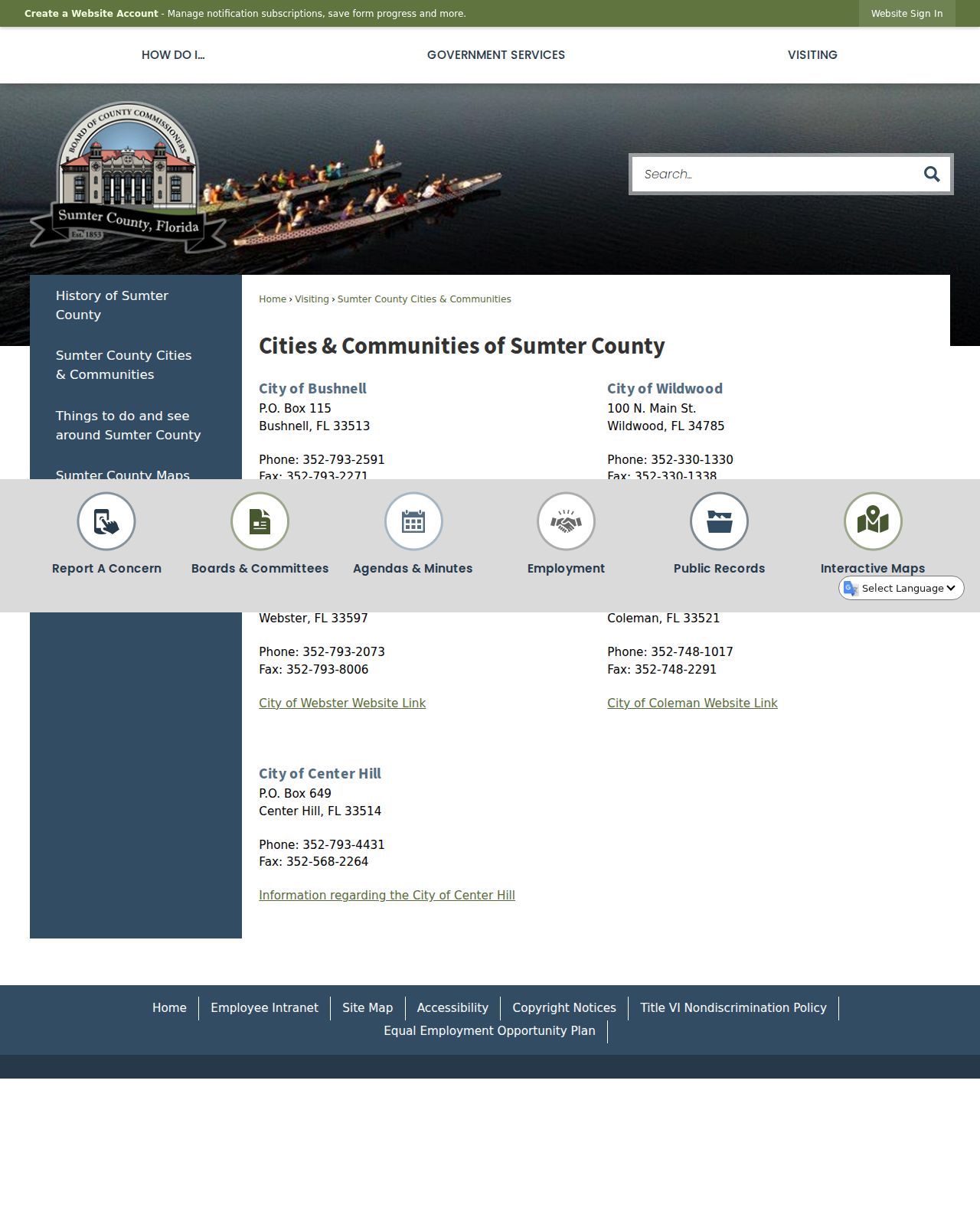
The Villages is prominent but is not incorporated, so it does not replace Center Hill in the population-ranked set. City-labelled calls on the live CAD screen are operational events, not verified city crime totals.
Wildwood's growth and separate police department make its route unique within Sumter County. A Wildwood arrest report starts with the city's Police Records Custodian, while booking still appears through SCSO and prosecution moves to the Sumter Clerk. Bushnell has used contracted sheriff service since 2012. Center Hill's agreement assigns the Sheriff municipal police-chief duties and includes dedicated deputy coverage backed by county patrol. Administrative copies of that contract belong to the county custodian, but incident reports belong to SCSO.
Wildwood's Special Magistrate should not be mistaken for a criminal court. That office hears recorded administrative code-enforcement matters. Criminal and ordinance prosecutions move through Sumter County Court, and felony cases move through Circuit Court. The same distinction applies in Bushnell and Center Hill, which have no municipal criminal court or city jail. Search the county systems after identifying the city source agency.